Thursday, March 7, 2013

Mad Cow Disease

The Bare Bones of Mad Cow Disease

Bovine Spongiform Encephalopathy, or Mad Cow Disease, is a neurological disease of cows. A cow with BSE may exhibit symptoms such as: nervous or aggressive behavior, abnormal posture, incoordination, difficulty standing, decreased milk production, and weight loss. The disease is progressive, which means that an infected cow may go three to six years before showing any sign of the disease.  So, what does that have to do with food safety? Well, we eat cows. And generally eating something that is diseased isn't very good for you. In fact, if a person eats a beef product that is contaminated Mad Cow Disease, they may contract the human version of Mad Cow Disease, which is believed to be caused by the consumption of infected cattle.

Variant Creutzfeldt-Jakob Disease
Variant Creutzfeldt-Jakob disease, or vCJD, can be caused by exposure to contaminated foods. Mad Cow Disease happens when the protein Prion changes and causes damage to the nervous system of cows. This same protein is what is believed to be the cause of vCJD in humans. There are other types of Creutzfeldt-Jakob Disease(CJD), one has no known cause, and the other is hereditary. vCJD is a form of CJD that is related to Mad Cow Disease. However, vCJD accounts for only 1% of CJD cases. While, vCJD is very rare, the cases of Mad Cow Disease has occurred at alarming rates. 

The Disturbing Truth Behind the Transmission of BSE
Mad Cow Disease is not a contagious infection. A cow doesn't sneeze and infect dozens of other cows in a meadow somewhere. Cows are infected by BSE when they are fed the meat and bone meal of other cows that are infected with BSE. 

As illustrated in the animation above, cows have four stomachs. None of which are used to digest other cows. The digestive system of cows are specifically designed for the consumption of grass. So, it's no surprise that when cows are fed something other than grass, mutations and illness occur. Besides the ethical issues surrounding the spread of Mad Cow Disease, there is also a serious food safety issue. While vCJD makes up 1% of CJD cases, it could easily be 0%. The spread of BSE could be avoided by simply allowing cows to do what they do best and eat grass. 

Final Thoughts on Mad Cows
Mad Cow Disease hasn't be in the news much lately, but it's still an issue that people should care about. The fact that Mad Cow Disease is an issue illustrates the unethical and sometimes dangerous practices of the food industry. Simply being aware of what happens before your food ends up on your table may help to combat the spread of illnesses such as vCJD and BSE, or even E. Coli or Salmonella. Awareness can bring to light these issues and spark change. 
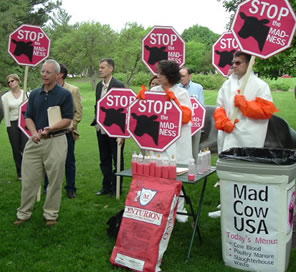


Further Reading: FDA

-Contributed by Karissa Francis


Deadly Cantaloupe

After an Oklahoma man's death from eating a cantaloupe contaminated by the Listeria monocytogenes bacterium, the source was linked to a single farm in Colorado. That same farm had shortly before been awarded a top safety rating and had been distributed to retailers such as Walmart. The contamination had contributed to 33 deaths, yet the FDA has minimal power to prevent tainted products from being distributed. Statistically, the death toll of Americans per year from foodborne illness is 3,000 out 128,000 people who get infected apparently from lack of government control.

Published by: Ramona Petrova 

http://www.bloomberg.com/news/2012-10-11/food-sickens-millions-as-industry-paid-inspectors-find-it-safe.html

15 Ways to Eat Safe

There are many simple ways you can reduce your chances of eating contaminated food. There are simple ways you could store and handle food that minimizes your chances of getting a foodborne illness that many people overlook. From the current public health scares of meat and raw fruits and vegetables, it is important to be conscious of the safe handling and consuming of store-bought foods or even if you get your food from a garden or from a farm.

Published by: Ramona Petrova

http://www.medicinenet.com/food_safety/article.htm
Horse Meat at Taco Bell

An article from the Chicago Tribune recently found horse meat in the ground beef at several Taco Bell outlets in the UK. The issue has fortunately been isolated to three chains where the testing of the beef had been overlooked. In result of current reports of horse meat, many fast food outlets have begun to tighten their food safety regulations as KFC discontinued using more than 1,000 slaughterhouses in fear of contamination of their chicken products.In Europe, the horse meat had spread to Ireland according to recent tests on their beef. As the horse meat was discovered in the meantime when it reached the public, the catering companies and fast food outlets are not certain if the meat was served to consumers.

Published by: Ramona Petrova

http://articles.chicagotribune.com/2013-03-01/business/chi-horse-meat-found-in-beef-at-taco-bell-in-britain-20130301_1_horsemeat-horse-meat-ground-beef

UK Petting Farm Found Liable for 2009 E. coli Outbreak

  A Surrey county petting farm in the UK has been found liable of a 2009 E. coli outbreak that infected 93 people. Most of the people infected were children and some of them suffered from permanent kidney problems. Infected animals in places like petting farms can easily infect many people because of their fur, saliva and even feces on the ground.

Published by: John Ayala

http://www.foodsafetynews.com/2013/03/uk-petting-farm-found-liable-for-e-coli-outbreak/#.UTkg4FeGcs8

128 Sick in 13 States with Salmonella from Chicken

128 people have been reported in 13 states to have been infected with salmonella. The states include: Alabama, Alaska, California, Hawaii, Idaho, Massachusetts, Montana, New York, Oregon, Utah, Virginia, Washington and West Virginia.

Over 30 percent of the ill persons were hospitalized but no deaths have been reported, with Oregon and Washington being to two states hardest hit with 39 coming from Oregon and 56 from Washington.

The outbreak has been linked to Foster Farms brand chicken because the Washington State Public Health Laboratories found Salmonella in four samples of the chicken in the homes of three of the people that were sick.

Published by: John Ayala


http://www.foodsafetynews.com/2013/03/128-sick-in-13-states-with-salmonella/#.UTkbG1eGcs8
"Superbugs" in Meat

Research conducted in 2011 shows that nearly half of all meat and poultry products are contaminated with a deadly bacteria. Many of the bacteria that infects meat products are drug resistant and the factory animal farms where the meat comes from is the source of the outbreak.The animals from those are dosed with antibiotics and vaccines that are creating imbalances in their immune system and therefore making them susceptible to drug resistant "superbugs" such as the deadly S. aureus, which can be fatal if ingested.

Packaged meat, on the other hand, has been found to contain a cancer-causing ingredient called sodium nitrite.It is an additive to meat products for more redness and is also proven to kill botulism. Recommendations for the safety of meat consumers is to buy locally and to thoroughly cook the meat to kill the potential pathogens.

Published by: Ramona Petrova

http://www.naturalnews.com/032111_fresh_meat_superbugs.html